

Commercial vacuum sealers streamline kitchen workflows by extending the refrigerated shelf life of food, letting you prepare in batches instead of repeating daily. However, the bag’s micron rating, film structure and size must match the sealer type, food category and HACCP cook-chill requirements.
If you’re looking for new ways to simplify and streamline your kitchen workflow while eliminating unnecessary tasks, let’s discuss how and why a commercial vacuum sealer might be your next worthwhile purchase.
A commercial vacuum sealer removes the oxygen from around the food before the bag is sealed. Oxygen feeds the bacteria and mould that spoil food, so removing it slows the process down. That’s the mechanism, and it’s what changes how a kitchen runs, not just how food looks in storage.
At home, that mostly means less freezer burn and faster marinating. In a commercial kitchen, the same mechanism changes the prep schedule. If sealed, chilled product stays safe for several extra days, a kitchen can cook a bigger batch once instead of a small batch every morning, allowing you to portion proteins, blanch vegetables, or finish a sauce in one run, then drawing down stock across the week instead of starting from scratch each day.
That workflow benefit only holds up if the bag does its job. A bag that punctures under vacuum or lets oxygen back in through the film cancels out the shelf life the whole batching plan depends on. So the bag matters more than the sealer brand, which is why it’s important to choose a bag that suits your machine and your food.
Most commercial kitchens run one of two sealer types, and each puts a different amount of stress on a bag.
External (or suction) sealers sit outside the bag. They draw air out through the open end, then crimp and seal it shut. They’re cheap, compact, and easy to run, making them a good fit for cafés and smaller kitchens with lighter volumes, mostly for dry food. The vacuum pressure is gentle, so a lighter film usually holds up. Suppliers typically spec this in the 70–100 micron range, though exact figures vary by brand.
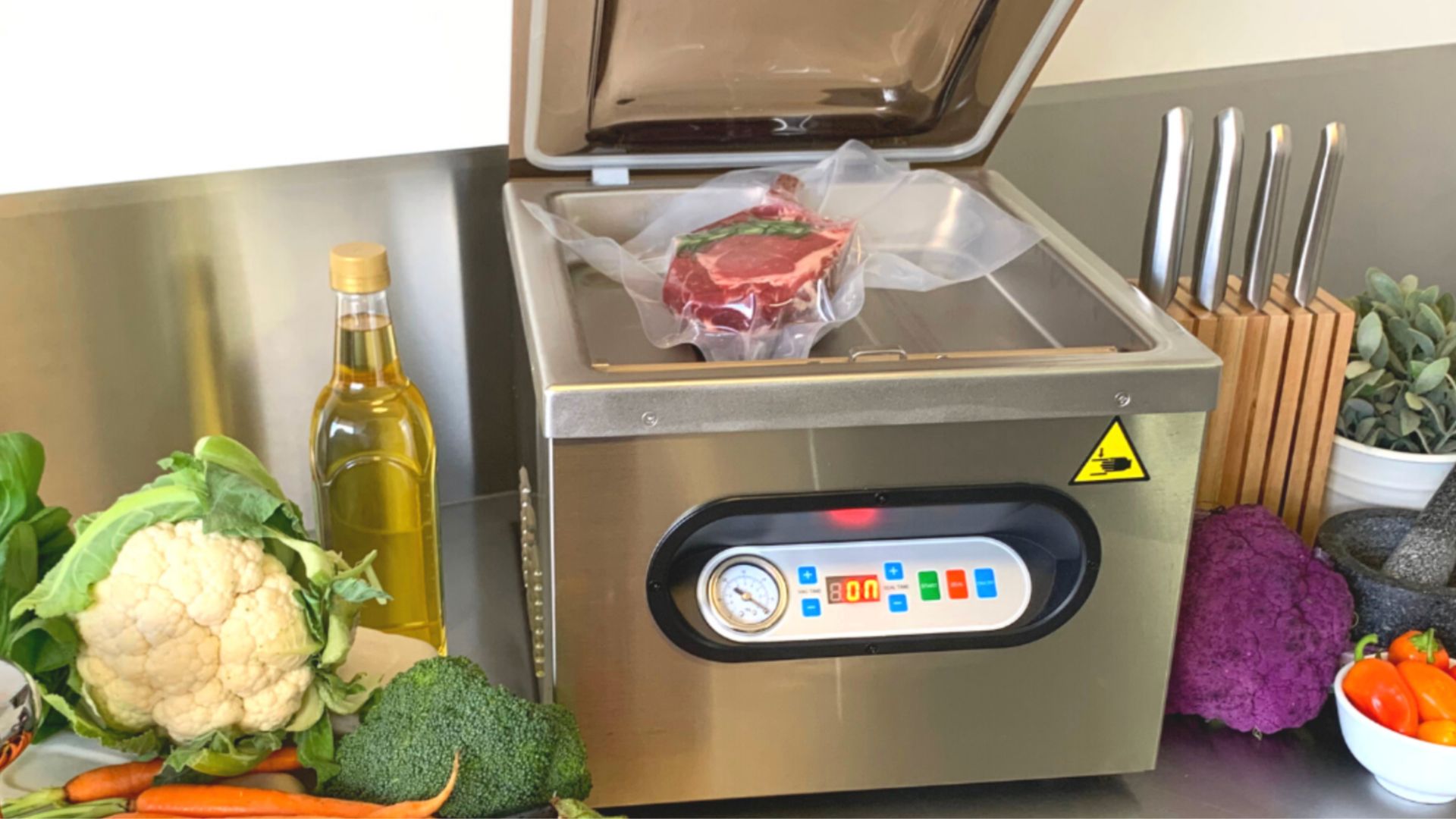
Chamber sealers work differently. The whole bag goes inside a chamber, and air is pulled from the entire chamber, not just the bag. That gives a stronger, more even vacuum, and it’s the only real option for liquids, marinades, soups, and sous vide. Because the pressure is higher and these machines tend to run harder in busier kitchens, the bag needs to be tougher too, typically 100–115 microns.
For cook-chill kitchens, 100–115 microns is the practical minimum for reliable seal integrity under commercial vacuum pressure. This is not a number written into a specific regulation, but a functional threshold below which bags are more likely to puncture or fail. Match the bag to the machine. The most common mistake we see is an under-specified bag going through a chamber sealer: the film wasn’t built for that pressure; it pinholes, and the product spoils early despite being “vacuum sealed.”
If you’re not sure which machine you have, look at how it seals. External units seal a bag sitting on top with an exposed heating strip; chamber units close a lid over the whole bag first.
These micron figures reflect general commercial packaging practice. Check your bag supplier’s spec sheet and your sealer manufacturer’s guidance for your specific model before you order in bulk.
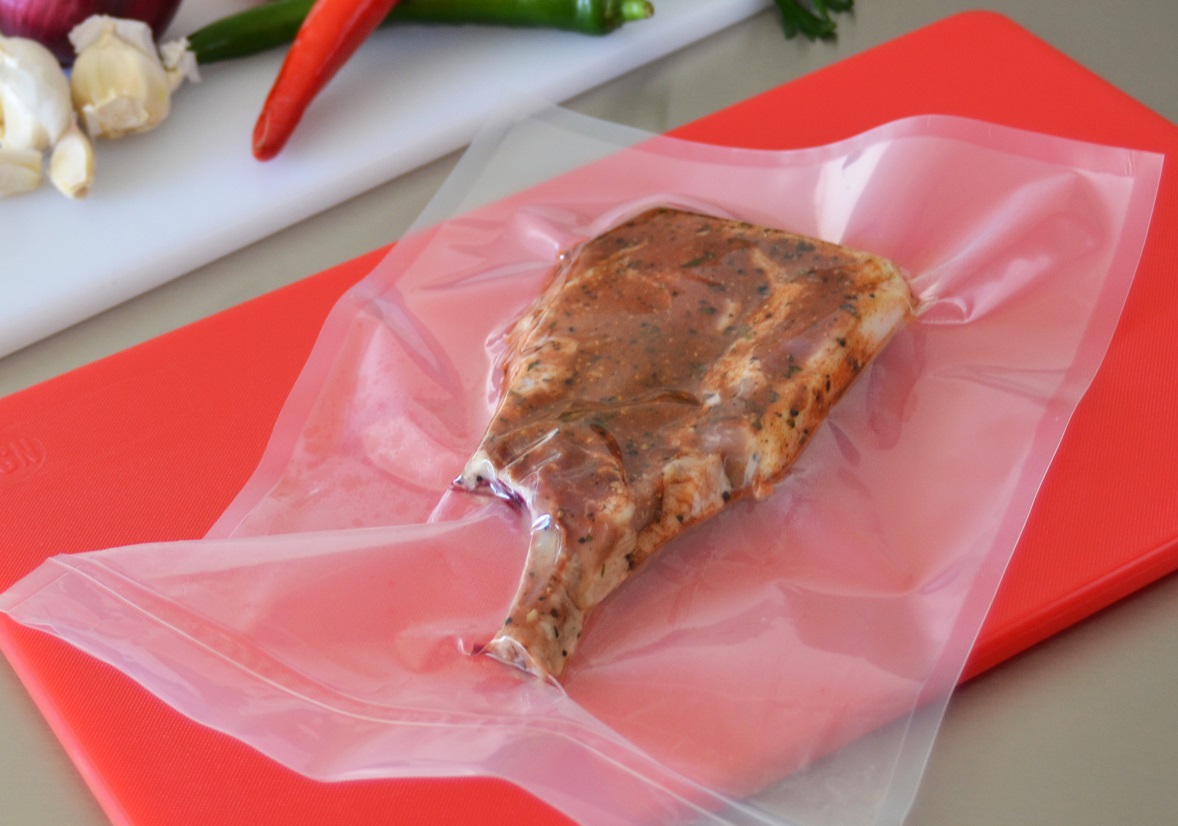
The micron rating tells you how thick a bag is. It doesn’t tell you how well it blocks oxygen. That depends on what the film is made of.
Most commercial vacuum bags use multiple layers. A common structure pairs a nylon (PA) outer layer with a polyethylene (PE) inner layer. The nylon provides most of the oxygen barrier. The polyethylene is food-contact safe and melts at the sealing temperature to form the seal. Some bags add a third layer, often EVOH, between the PA and PE for an even lower oxygen transmission rate, which matters if you’re pushing shelf life on liquids or long cook-chill holds. Together, the layers set the bag’s oxygen transmission rate, or OTR, which is how much oxygen gets through the film over time.
Two bags of the same thickness can perform very differently in the fridge if the film underneath is different. A lower OTR generally means a longer, more stable shelf life. It’s worth asking your supplier for the actual OTR figure and the test standard it was measured against, rather than accepting “food safe” as a stand-in for barrier performance. Ask for a tested value tied to the specific bag you’re buying, not a generic spec sheet for the film grade.
Shelf life extension isn’t the same across every food type, and the bag isn’t doing it alone — oxygen exclusion, correct chilling, and an unbroken cold chain all play a part.
As a rough guide for cook-chill kitchens working to HACCP:
The exact number of days will vary depending on your kitchen, your product, and how tightly you run your cold chain. Treat published ranges as a starting point to check against your own HACCP plan, not a fixed promise.
Note: These figures all assume the food was chilled quickly after cooking and held at a safe temperature the whole time. A bag can’t fix a slow chill-down or a broken cold chain, no matter how good the seal is. If your kitchen runs a documented cook-chill program, your exact chill time and holding temperature should come from your HACCP plan and the current FSANZ Food Standards Code.
Bag size is where most kitchens guess instead of thinking it through. It’s an easy fix once you stop sizing to the tray and start sizing to the product.
Smaller bags suit individual portions and single-serve plating. Mid-size bags suit bulk protein cuts and GN 1/2 batches. Larger bags suit GN 1/1 production runs and hotel pans.
Size the bag to the filled product, not to the outer edge of the tray it came off. A bag that’s too big for its contents leaves loose film to fold and crease around the seal line, a common cause of a weak seal. Give the heating element a clean, flat surface, with enough margin around the product but no more.
Before you commit to a spec, check the paperwork. In Australian food service, procurement and HACCP audits generally expect vacuum bags to be:
If a supplier can’t hand over that documentation for the exact SKU you’re buying, that’s worth pausing before you place a bulk order. An auditor asks for the document. They don’t accept the marketing copy.
If you put the three specification decisions together, the case gets simpler, not more complicated. A bag matched to your sealer won’t puncture; a bag with the right film holds its barrier for the length of your production run; a bag sized to the product seals cleanly. Get those right, and you avoid the two things that cost kitchens the most: product spoiling before it’s used and prep cycles running daily when they didn’t need to.
We won’t put a number on how much waste or labour this saves you. That depends on your current prep schedule, your portion sizes, and how much spoilage you’re already absorbing, and any figure we gave you here would be a guess wearing a stat’s clothing. What we can say is that the mechanism holds: get the bag spec right, and batching becomes a safe option instead of a bet.
From here, it’s a spec decision. Confirm your sealer type, choose the appropriate micron thickness, check the film and certification against your HACCP plan, and select a bag that suits your format, whether it’s a GN 1/1 full-size Gastronorm tray, GN 1/2 half-size Gastronorm tray, catering tray or individual portion tray.
So, where do you go from here? Pac Food stocks both commercial vacuum sealers and vacuum-sealing bags, filtered by micron thickness, size, and certification, so you can shop by spec instead of guessing. Simply order online today and improve your kitchen workflow.